
TL;DR: Companies now process 375 applications per role and conduct 20 interviews to make one hire. High volume made hiring teams pickier, thinking they can find perfect candidates. Instead, time-to-hire increased 28% and bad hires still happen. The problem: signal-to-noise ratio is broken at the source. WIP fixes this with verified referrals that require identity checks and $20 stakes per intro. Result: 85% less volume, 60% faster hiring, much higher confidence.
The Numbers That Break Recruiting
Last year, three fast-growing tech companies shared their hiring data:
- Revolut: 1.6M applications for 5,000 roles
- Deel: 1.3M applications for 3,000 roles
- ElevenLabs: 210K applications for 300 roles
That averages to 375 applications per open position across 8,300 total roles. Not unique candidates, just raw application volume.
Gem's 2026 Recruiting Benchmarks Report analyzed 165 million applications and 1.2 million hires across the industry. Their finding:
companies now conduct an average of 20 interviews to make a single hire.
Let's run the math on what that actually means.
Interview Load Reality Check
With 375 applications per role and 20 interviews required per hire, here's the recruiting funnel:
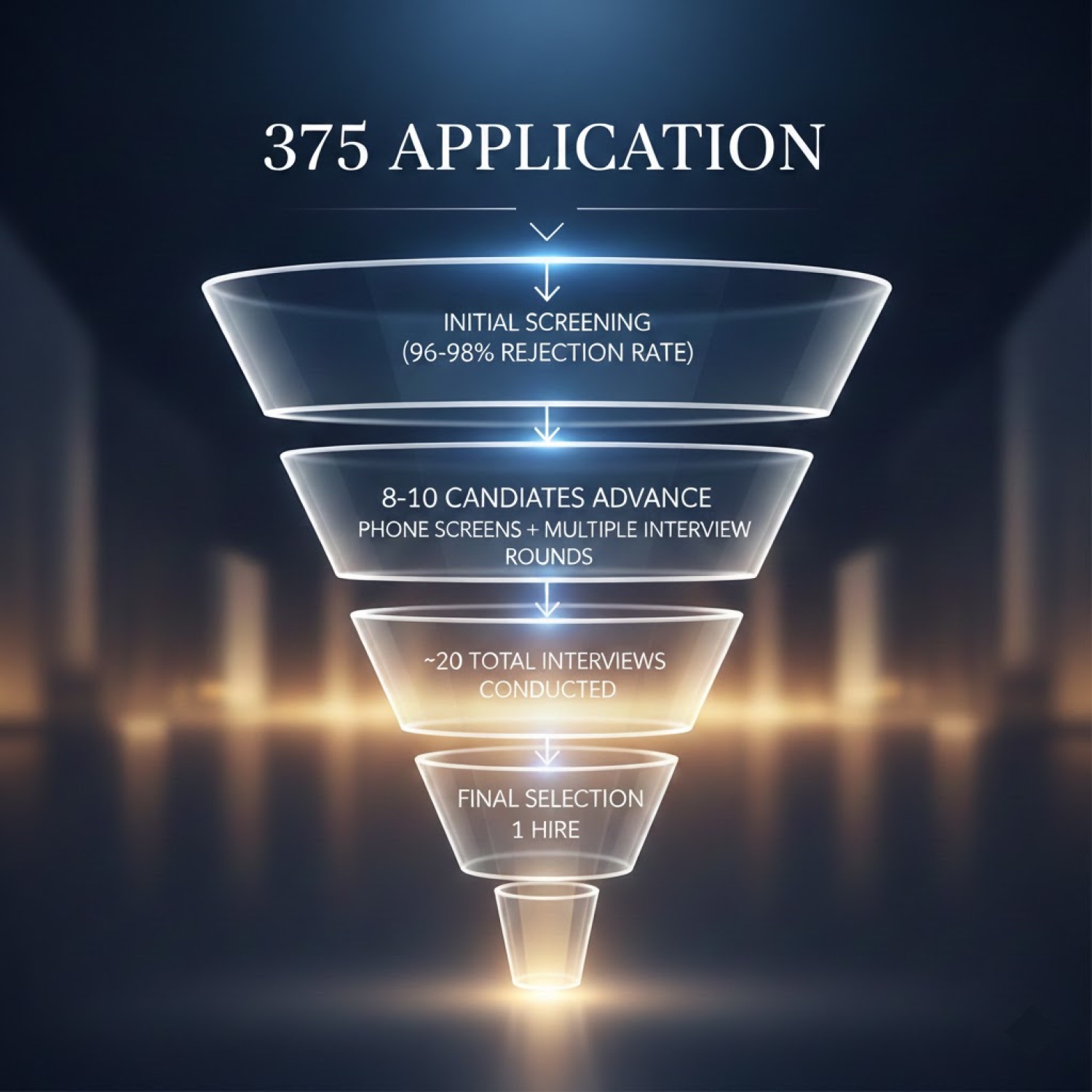
If each interview takes 45 minutes and you're hiring for 100 positions:
- 37,500 applications to process
- 2,000 interviews to conduct
- 1,500 hours of interviewer time
- 90 days average time-to-fill
For one hiring cycle. For 100 people.
And this assumes your screening is perfect and you're only interviewing qualified candidates. In reality, many of those 20 interviews include people who looked good on paper but weren't actually a fit.
Why Adding More Process Doesn't Work
When companies see high application volume with low conversion, the instinct is to add more:
- More recruiters to handle the load
- Better ATS systems to filter faster
- More interview rounds to reduce bad hires
- Behavioral assessments and trial projects
But here's the problem: you can judge technical skills in two good interviews. What you can't judge in any number of interviews is whether someone will tank team culture, become a toxic presence after 90 days, or simply wasn't as motivated as they seemed.
Because interviews are performances. Some people are exceptionally good at performing.
A bad hire in a 50-person company doesn't just waste salary. It destroys team morale, damages customer relationships, and can send your company's reputation to zero. Especially in small teams where there's nowhere to hide and every person's behavior affects everyone else.
The Pickiness Trap
Here's what actually happened when application volumes exploded: companies became more selective, not smarter.
When you're getting 375 applications per role instead of 50, the thinking goes: "With this many candidates, we must be able to find someone exceptional. Let's add another interview round. Let's make the bar higher. Let's wait for the perfect candidate."
So companies keep adding rounds. The average interview process went from 3 rounds to 5+ for senior roles. Time-to-hire increased 28% compared to pre-2020 benchmarks. Hiring teams spend months searching for unicorns in a pile of applications that looks impressive but is mostly noise.
And they're still making expensive hiring mistakes. Because volume doesn't equal quality, and being pickier doesn't help when you're picking from the wrong pool.
The Real Problem: Signal vs. Noise
Gem's data reveals something critical about hiring sources:
Job boards: 50% of all applications → 27% of hires
Referrals: 1.6% of applications → 16.8% of hires
Referrals deliver an 11x better yield than job boards. You get 10x better conversion with 1/30th the volume.
Why? Because referrals come with built-in social proof. Someone staked their professional reputation on that introduction. They know the candidate well enough to vouch for both skills and cultural fit.
But traditional referral programs fail at scale:
- Employees rarely refer people (0.3% of total applications come from internal referrals)
- No accountability if a referral fails
- Limited networks (you can only hire people your team already knows)
- Inconsistent quality and follow-through
How WIP Solves the Volume Problem
WIP flips the hiring model by adding accountability and verification before anyone enters your pipeline. Here's how it works:
Every referrer must:
- Complete identity verification (KYC)
- Stake $20 of their own money per candidate referral
- Confirm the candidate gave explicit permission
- Only gets paid if you hire AND the person succeeds through probation
No stakes, no referral. No trust, no payout.
This creates a hiring funnel that starts with quality:

You're not eliminating your interview process. You're starting with candidates who have someone's reputation and money attached to them. Someone who knows them well enough to risk both.
The math changes completely:
- 85% less application volume to process
- 60% reduction in time-to-hire (based on current WIP client data)
- Much higher confidence that culture fit and motivation are real
- 100% refund if they fail probation within 90 days
Companies using WIP report they're not screening faster. They're screening less, because there's less noise to screen in the first place.
Also, WIP handles all tracking, attribution, and payouts— so you can focus on closing hires, not managing spreadsheets.
Why This Matters Now
Hiring in 2026 looks nothing like hiring in 2020. Application volumes tripled while team sizes stayed flat or shrank. Recruiters now manage 72% more requisitions than three years ago.
The strategies that worked when companies struggled to attract candidates don't work when you're drowning in applications. Job boards optimized for reach now create volume problems. LinkedIn Easy Apply turns serious candidates into spam.
The companies winning at hiring aren't the ones with the biggest budgets for job ads or the most sophisticated ATS systems. They're the ones who figured out how to get signal before the noise starts.
That's what WIP does. We don't make screening faster. We make it unnecessary for 90% of your pipeline.
Because the best hires don't come from the biggest candidate pools. They come from trusted networks with accountability built in.
Want to see how verified referrals work for your hiring?
I'm running WIP and talking to companies dealing with exactly this volume problem. If you're hiring and drowning in applications that don't convert, let's talk about what's actually working.
DM me, let’s fix hiring together!
One referral at a time, one company at a time!
More info: wip.expert