Nordau Shift
A chess variant
You don't own your seat.
Chess for three. Two at the board, one standing, and every few moves a coin decides who gets up.
Also known as Carousel Chess
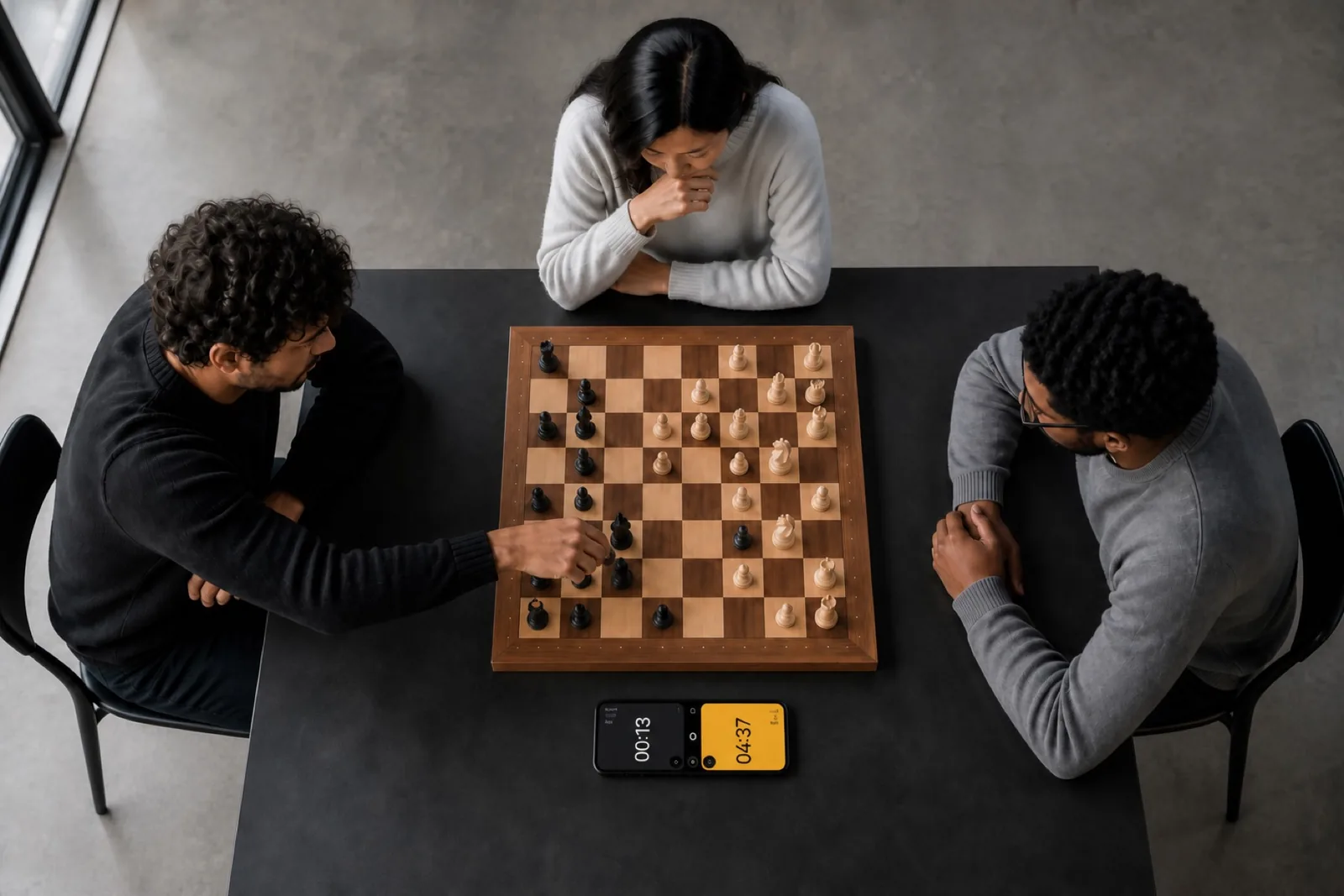
A shift runs three to six moves. Nobody is told which.
When the shift ends, a coin picks a seat. Whoever is in it gets up, the player standing takes it, and the game carries on from the exact position they were watching. Same pieces, same move to play, different hands.
The shift length is drawn before the game and stays sealed until it fires. If players could count down to a rotation, they would time their mates and stall out of lost positions. That is the whole reason it is hidden.
White
plays the pieces
Black
plays the pieces
Standing
watches, no clock
The coin names a seat. Whoever is sitting in it stands up and starts watching.
The player who was standing takes that seat, with that colour. The third player does not move.
The position belongs to the board, not to the person.
Castling rights, an en passant square and the repetition count are properties of the side, and they pass to whoever is sitting behind it. You inherit the rights and the obligations of the seat you take.
There is no way to change colour directly.
The only route from one side to the other runs through the standing spot and depends on a coin, so wrecking your own position to escape it is pointless: half the time you will still be sitting behind it.
Fifteen seconds a move, and nothing survives the rotation.
Each move hands you a block of fifteen seconds. There is no increment of any kind. What you don't spend rolls into your next move, but only inside the current shift. The moment the seats change, both banks go to zero and everyone starts from one block again.
One block per move
Credited when you finish the move before it, so you can plan the reply while your opponent thinks.
Increment
None. Playing fast pays you in the block you keep, not in seconds added afterwards.
Seat-down bonus
Half a block, once, for the player arriving from the standing spot. Enough to read the position you inherited.
Bank at every rotation
Both seats reset. Hoarding time across a shift is not a plan, it is a leak.
Running the bank to zero is a loss on time, scored exactly like a checkmate. The block size can be put on a schedule for longer games, but the default is a single flat row and most games never need more.
What it does to your chess
The variant was built for a street club, so it had to be fun first. What surprised us is how much of it is training. Four habits it forces on you. Your usual way of playing will not get you out of any of them.
Time management
Saved seconds are not savings.
Every rotation wipes the bank, so time you carefully did not spend is time you handed back. You stop budgeting for a long game and start spending at the rate this shift is worth. Chess clocks teach you to ration. This one teaches you to price a move and pay for it now.
Defence into attack
The position stays. Your job flips.
You spend four moves holding a bad structure together, then the coin sits you behind the pieces you were defending against. Every weakness you were nursing is now a target you have to hit.
Move efficiency
If the mate is there, it lands now.
A rotation can come after any move from the third one on. Spend a move improving a piece before the combination and you may be standing up while somebody else plays it. The point goes to whoever is sitting when the game ends.
Strategy under a moving floor
Three or four moves of plan at a time.
Each shift opens the same question in a different position: finish it here, build an advantage solid enough to survive without you, or keep the game quiet and stay out of trouble. You answer it, play it out, and then answer it again with the other colour in front of you.
Points go to the seats, not to the people who built the position.
Whoever occupies a seat when the game ends takes what that seat scored. Standing is not a punishment. It pays one point, more than a loss and less than a win, so giving up your chair is never worth engineering.
Checkmate, flag or resignation
Any draw, and a draw needs all three to agree
Why the game answers to two names
One name describes the mechanic. The other says where it came from. Both stayed, because at the club everyone uses the second one anyway.
Primary name
Nordau Shift
Nordau Boulevard, Tel Aviv. The chess club on the boulevard is where the game was invented and first played, and it is where every rule above got argued over a real board. A shift is also the unit the game runs on, which made the choice easy.
Also known as
Carousel Chess
The working name, and still the clearest description of what happens: three players going round two seats, one of them always off the ride. Useful when you are explaining the game to somebody who has never seen it.
Why I made it
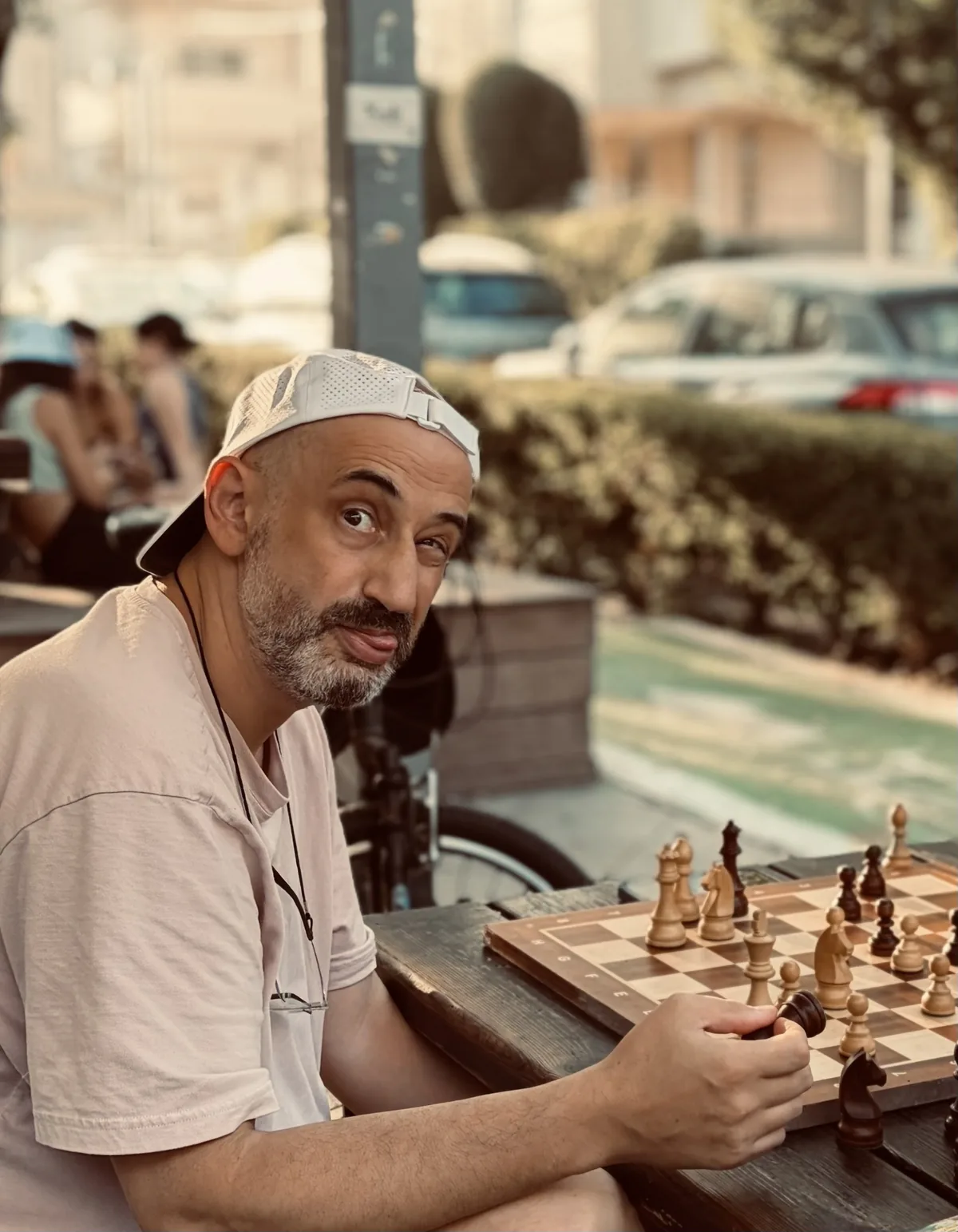
I learned chess at four and never quite left. Chess school from seven to eleven, up to first adult category. Then I got bullied at school and went to wrestling instead, and the board sat untouched for years. Chess.com pulled me back in 2013. Twenty-two thousand puzzles and about five thousand blitz games later I am over the board almost every day, with the street chess community on Nordau in Tel Aviv.
I think chess is one of the most under-monetised great games there is. The clearest signal: fewer than about five hundred players in the world can make a living from playing it. For a game with this reach, this history and this much online play, the commercial surface is strangely small.
The part that interests me most is offline: street boards, clubs and schools. A game like this one changes what people expect from an evening with a board. It is entertainment first, and it teaches on the side.
Take the game. Teach it. Run it at your club.
The rules are meant to be used, not guarded. The licence below lets you copy, adapt and run the game commercially, as long as you credit the source and pass the same freedom on.
Rules, copy, artwork
CC BY-SA 4.0
Share and adapt for any purpose, including commercially. Credit Mike Daykhin, creator of Nordau Shift, link back, say what you changed, and publish your version under the same licence.
Read CC BY-SA 4.0Not included
The app
The referee and clock are free to use in the browser. Their source code is not published, and the licence above does not cover them.
The name and the logo
The Nordau Shift name and mark, and Mike's name, likeness and biography, stay outside the licence. Refer to the game by name freely. Presenting your version as the official project or as endorsed is the one thing the licence does not cover.
Copyright 2026 Mike Daykhin. This is a plain-language summary of the licensing, not legal advice; the licence text governs.
Bring a third player.
You need a board, pieces and one phone on the table. The app runs the draw, the hidden shift lengths, the coins, both clocks and the score, and it publishes a hash of its randomness before the first move so anyone can check it afterwards.
Free, runs in the browser, works offline once loaded.
The app is still in development. Updates will be published on this site.